
From Obscurity to Recognition: The Rediscovery of an Attic Greek Bell Krater
Ancient Greek vases have long captivated collectors, scholars, and museum visitors alike. Their painted scenes offer vivid glimpses into a world that flourished more than two millennia ago, while their journeys through time often prove just as fascinating as the stories they depict. Such is the case with this exceptional Attic red-figure bell krater attributed to the Kadmos Painter and dating to approximately 420–390 BC.
Today, the vessel is recognised as an important example of Classical Athenian pottery, yet its remarkable history was not fully understood until recently. When acquired in 2024, the krater was known to be an authentic work of ancient Greek art, accompanied by scientific authentication, and scholarly assessments. What remained hidden, however, was the extraordinary story of its earlier provenance, a story that would ultimately connect the vase to some of the most significant collectors in the history of classical antiquities.
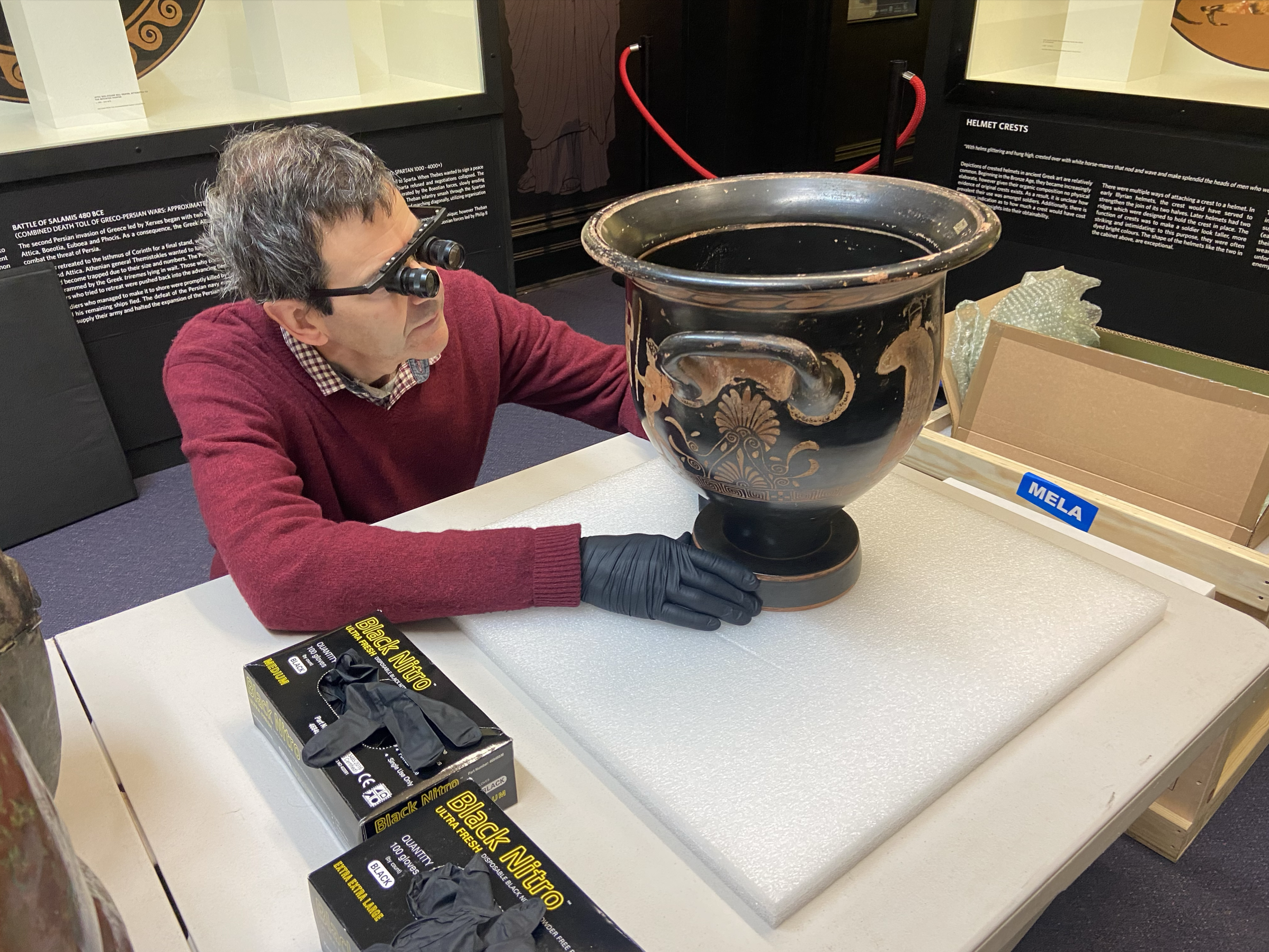
The vessel itself is a striking example of the bell krater form, a shape developed during the Classical period for use at the symposium, the formal drinking gatherings that occupied a central role in Greek social life. Characterised by its inverted bell-shaped body, broad mouth, horizontal handles, and elegant pedestal foot, the bell krater served as the mixing vessel in which wine and water were combined before being served to guests.
Standing on a high foot, this particular example displays many of the decorative features associated with fine Athenian pottery. A laurel wreath encircles the neck, while alternating checkerboard and meander patterns decorate the lower body. Beneath the handles appear tongue-pattern roundels, palmettes, and flowing tendrils, all executed with the confidence and precision expected of a master workshop.
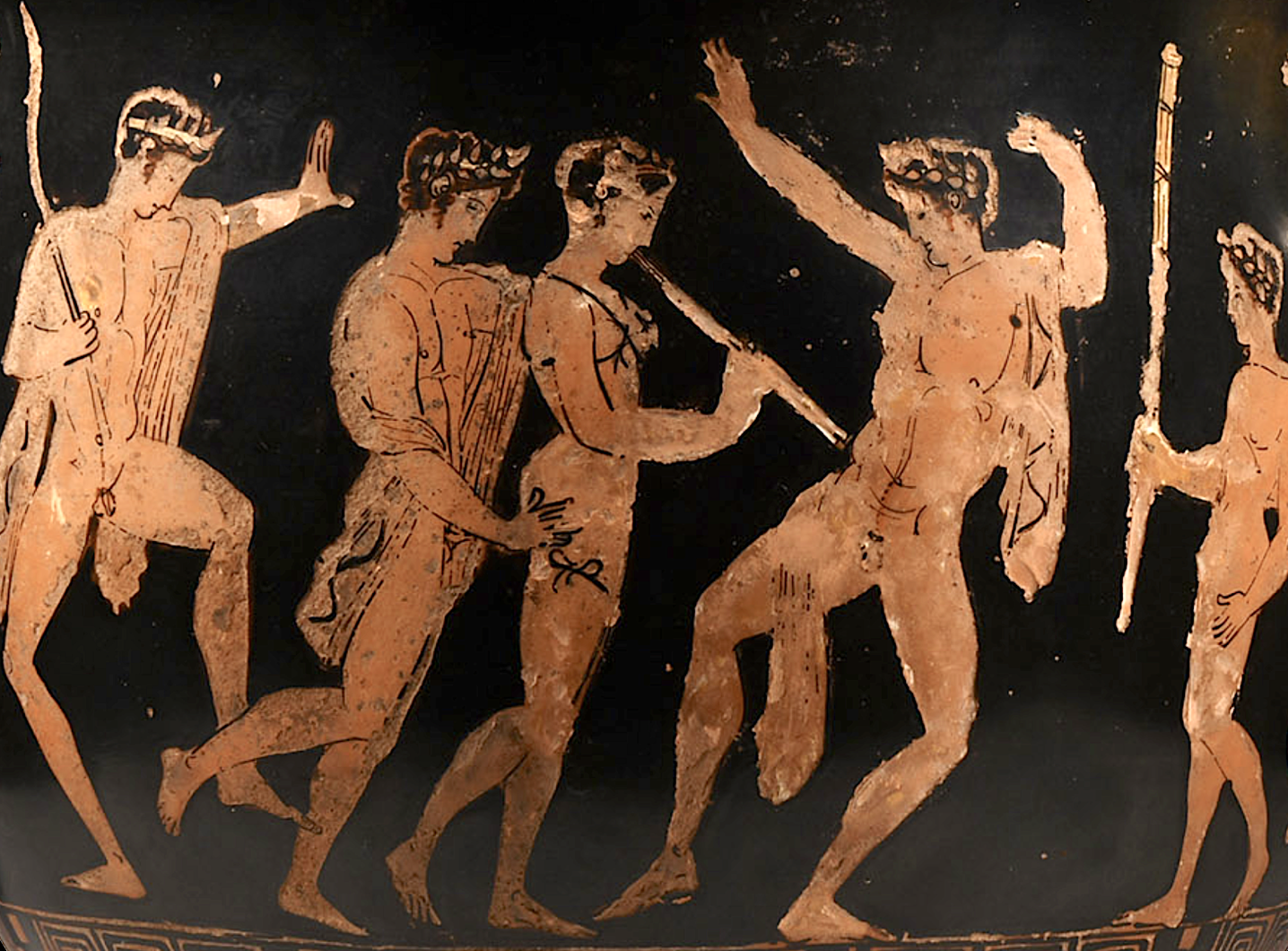
The principal scene depicts a lively komos, a festive procession associated with Dionysus, the Greek god of wine, theatre, and celebration. Five figures animate the composition: a youthful torchbearer, a double-flute player, and three dancers engaged in rhythmic movement. The scene captures the energy and spirit of Dionysian festivities while demonstrating the painter's remarkable ability to convey motion and interaction.
On the reverse, a quieter scene unfolds. Three draped figures engage in conversation, with a central female figure standing between two opposing male figures, one carrying a staff. While less dramatic than the celebratory procession on the front, the scene reflects the sophisticated narrative style characteristic of late Classical Athenian vase painting.
The krater has been attributed to the Kadmos Painter, an accomplished Athenian artist active between approximately 420 and 390 BC. Although his true name is lost to history, his distinctive artistic style allowed the great classical archaeologist Sir John Beazley to identify and group his surviving works. Named after a vase depicting the mythical hero Kadmos, the painter is known for his elegant compositions, refined draughtsmanship, and carefully observed figures. The present vessel is recorded in the Beazley Archive Pottery Database and represents an excellent example of his work during the final decades of the fifth century BC.
Like many Greek vases collected during the eighteenth and nineteenth centuries, the precise archaeological findspot of the krater remains unknown. Nevertheless, the available evidence strongly suggests that it was excavated from a tomb in southern Italy, most likely in Campania near Capua or Nola. These regions yielded vast numbers of Attic vases during the great age of antiquarian exploration, when collectors and dealers sought out the artistic treasures of Ancient Greece for European collections.
The most compelling aspect of the krater's story, however, lies not in its creation but in its rediscovery.
When the vessel was acquired in March 2024, it carried with it several old labels, accession numbers, and inventory marks. These remnants hinted at an earlier collecting history, yet no complete provenance had been published or assembled. Although references to the vase existed in scattered records, its full ownership history had effectively been lost.
What followed was an extensive programme of research and investigation. Historic auction catalogues were examined. Collection inventories were reviewed. Early publications, dealer archives, exhibition records, and surviving labels were carefully compared. Piece by piece, a forgotten history began to emerge.
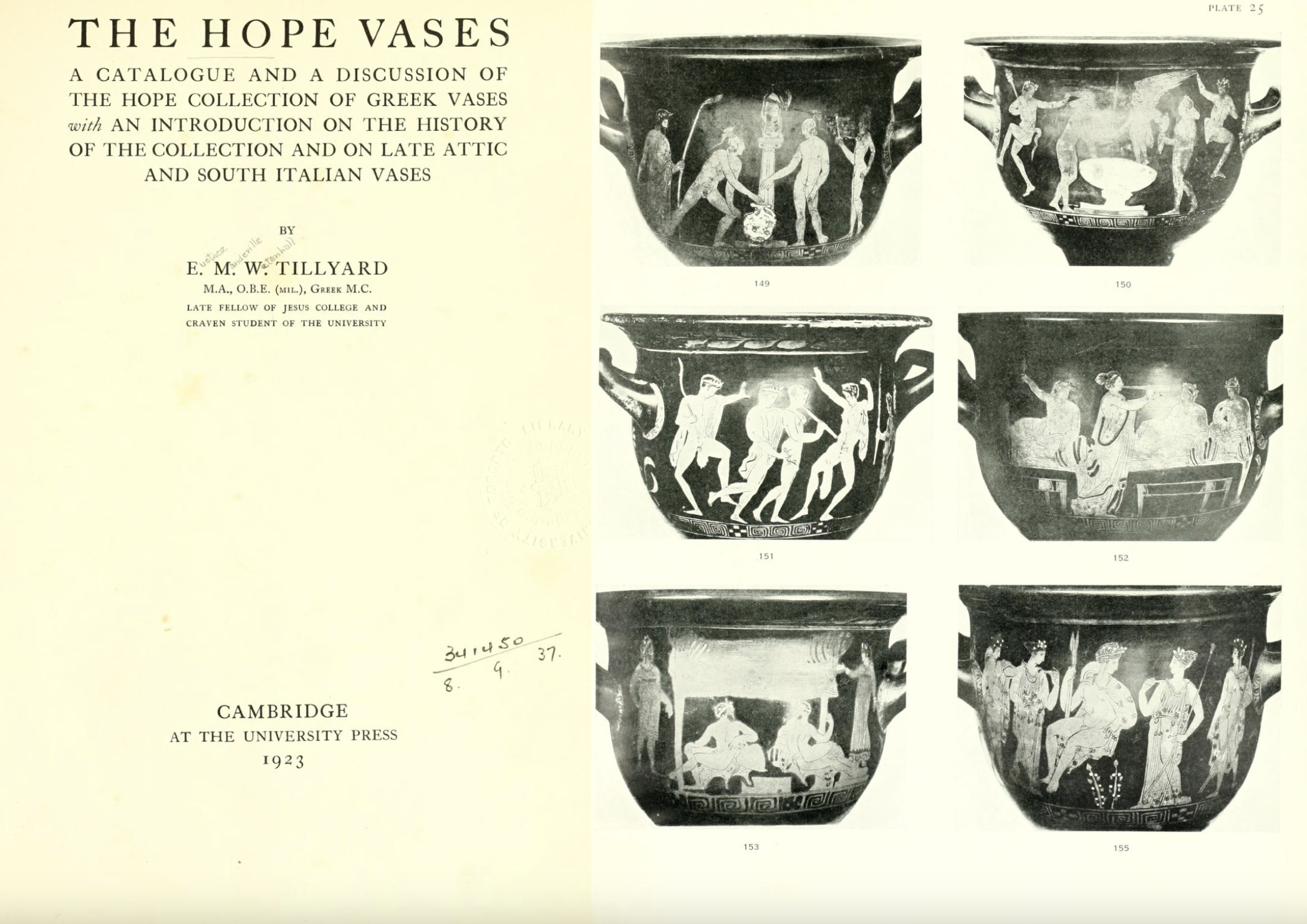
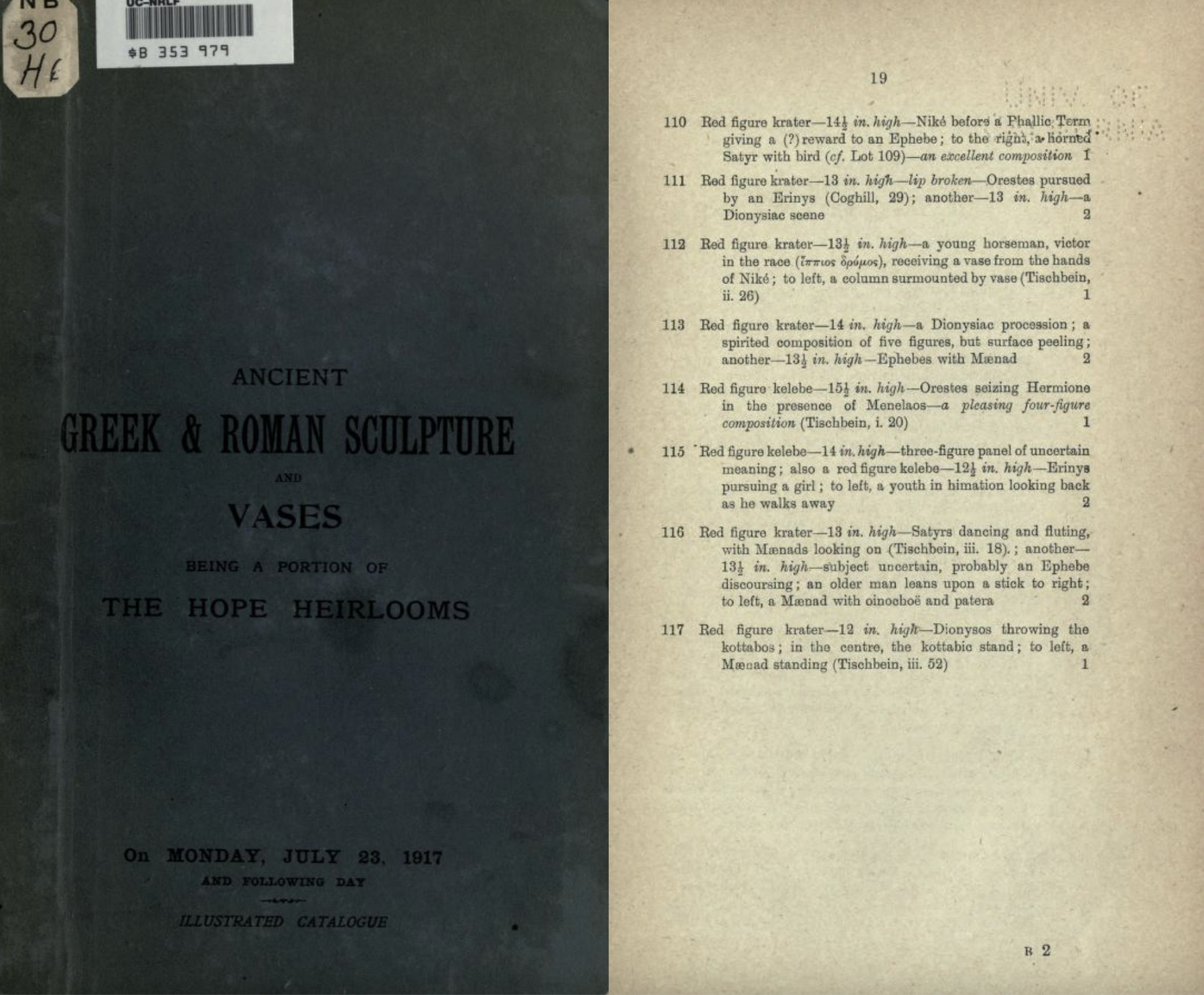
The breakthrough came with the identification of the vessel in the famous 1917 sale of the Hope heirlooms at Christie's in London. Surviving labels on the krater corresponded with descriptions and lot numbers recorded in the catalogue. From there, further research revealed that the vase had once belonged to Lord Francis Pelham Clinton-Hope and, before him, to the renowned collector Thomas Hope.
The trail did not end there.
Continued investigation ultimately connected the vessel to Sir William Hamilton, British Ambassador to Naples and one of the most influential antiquarians of the eighteenth century. Hamilton's collections transformed European appreciation of Greek art and inspired generations of scholars, artists, and collectors. Acquired as part of his celebrated second vase collection, formed between 1772 and 1795, the krater likely entered his possession shortly after excavation from a Campanian tomb.
The reconstruction of this provenance fundamentally transformed our understanding of the vessel. What had initially appeared to be an exceptional but relatively isolated work of ancient Greek pottery was revealed to possess a documented history spanning more than two centuries of collecting, scholarship, and cultural stewardship.
As the investigation continued, additional references were identified in important publications, inventories, exhibition catalogues, and dealer records. The vase was found to have been published in the Hope collection, recorded in twentieth-century inventories, exhibited internationally by Phoenix Ancient Art, and displayed in major exhibitions including Heroes & Hoplites: Warfare in Ancient Greece and The Olympics at the Hellenic Museum in Melbourne.
Scientific analysis further supported its authenticity. Thermoluminescence testing conducted by Oxford Authentication in 2011 confirmed the ancient origin of the ceramic body. The vessel has also been studied by several respected specialists, including Dr Jacques Chamay, Dr Raffaele D'Amato, Tim Wonnacott, and conservation specialist and archeologist Bruno Bell.
In 2024, the krater underwent professional conservation treatment involving careful cleaning and desalination. Importantly, it remains completely intact and unrestored, retaining its original foot and handles. Wear around the handles, interior surface, and painted decoration serves as a tangible reminder that this was not merely an object of beauty, but a vessel that was once actively used within the social world of Classical Greece.
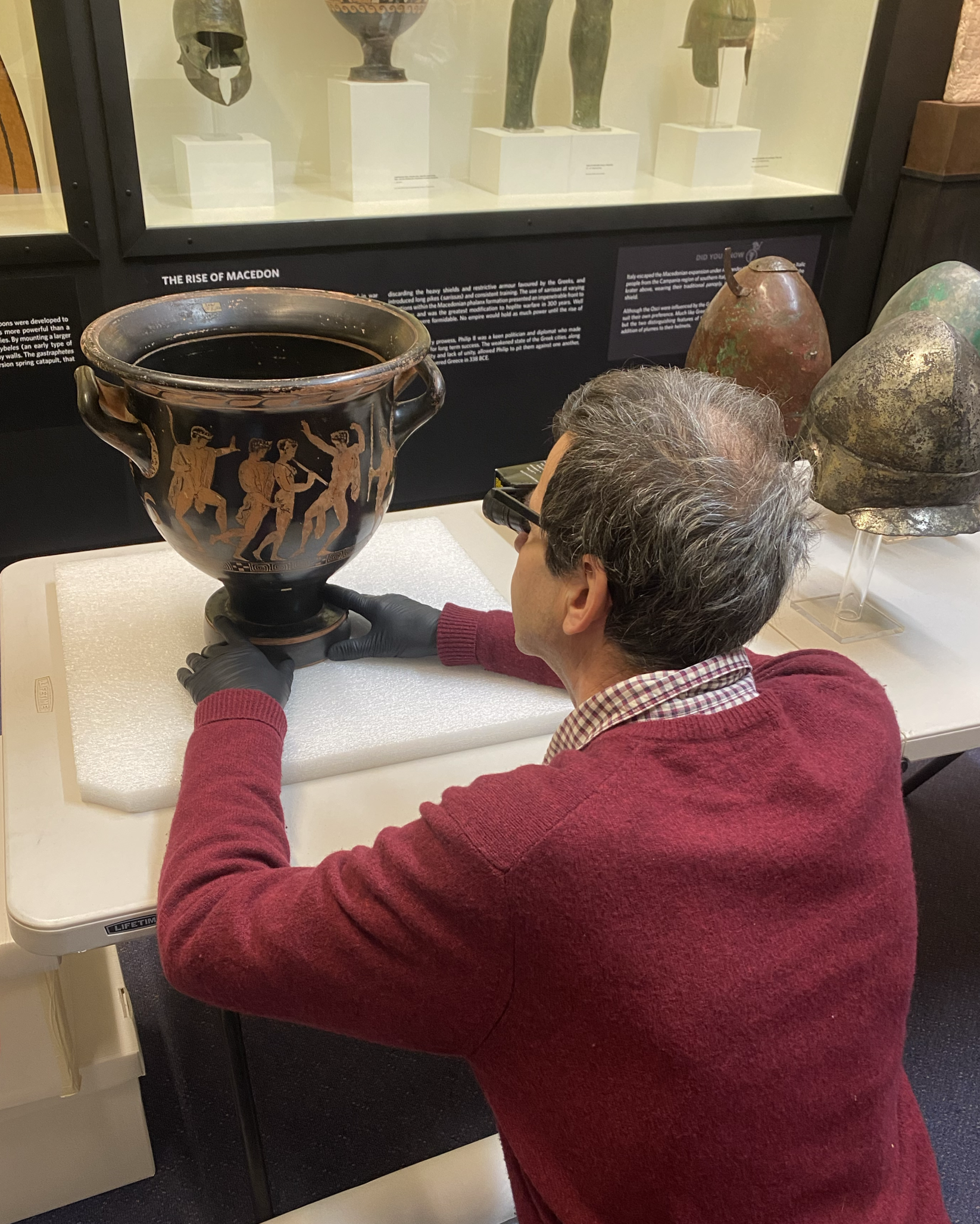
The rediscovery of the krater's provenance demonstrates the importance of ongoing research in the field of ancient art. While the physical object had survived for more than 2,400 years, much of its modern history had faded from memory. Through systematic investigation, a remarkable chain of ownership was reconstructed, reconnecting the vase with some of the most significant figures in the history of collecting.
Today, the krater stands as more than an outstanding example of Attic red-figure pottery. It serves as a witness to centuries of excavation, collecting, scholarship, preservation, and rediscovery. Its journey from an ancient workshop in Athens to a tomb in southern Italy, through the collections of Hamilton and Hope, and ultimately into the hands of a modern collector, reminds us that every antiquity possesses not one history, but many.
The story of this bell krater is therefore not simply the story of an ancient vase. It is the story of how careful research can restore forgotten histories, recover lost connections, and bring an object once obscured by time back into the light of recognition.